December in Chennai means only one thing, if you know where to look.
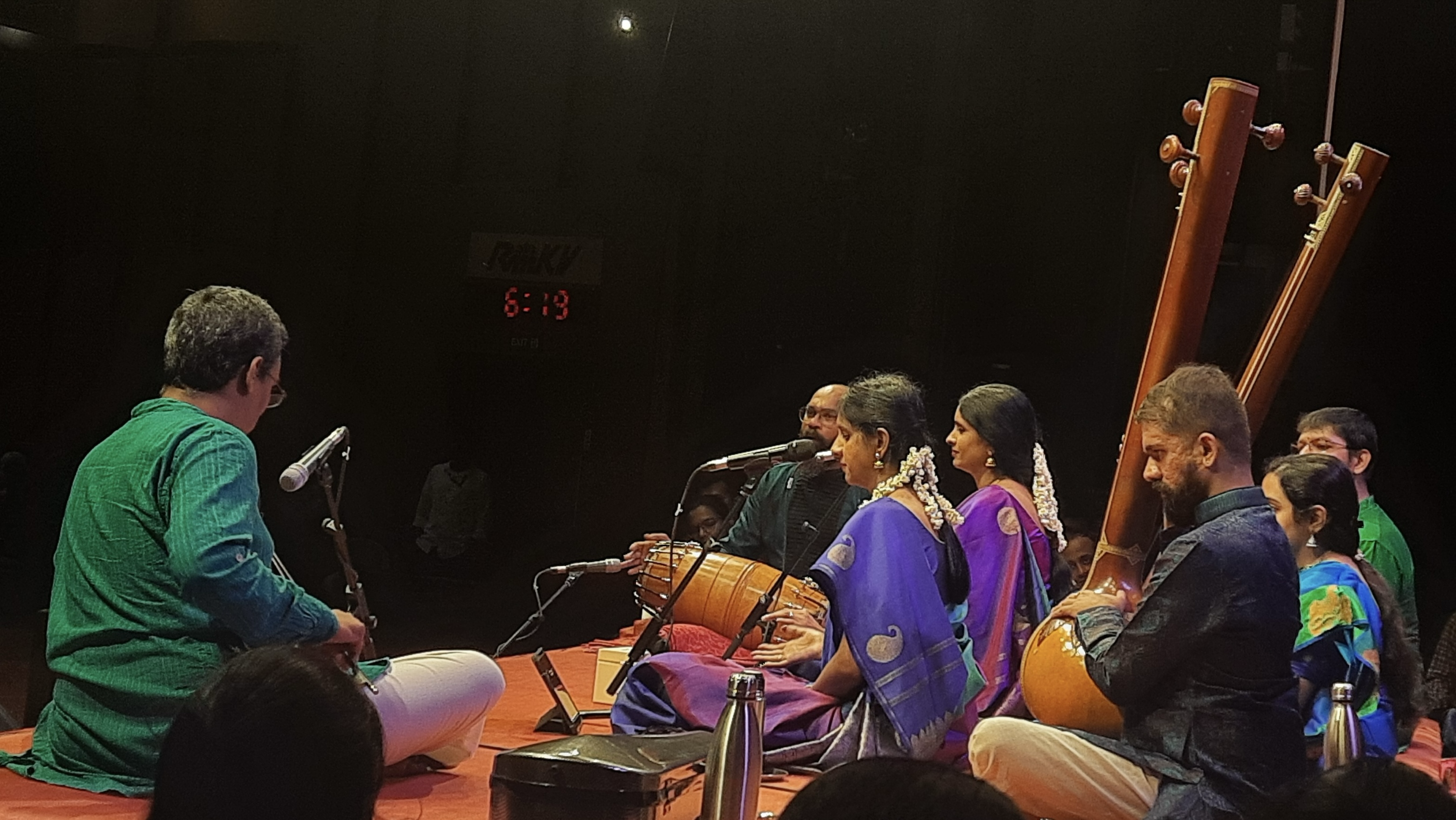
Margazhi is Chennai’s Annual December Music Season where the city turns into a maze of Carnatic Music concerts. For the ten days I spent during this time in Chennai, I organized my entire routine around the Season, from morning to night.
Carnatic Music has long been closest to my heart, and visiting Chennai for Margazhi feels like experiencing it in its grandest, most larger than life form.
Planning for Margazhi is not casual. It is a full scale scheduling problem. Every Sabha (venue hosting concerts) has multiple concerts a day. Gazillions of Sabhas in Chennai, all running simultaneously. Every hour, there is a choice to be made. Which artist, which venue, which concert might end up becoming one of those once-in-a-lifetime experiences.
I had spreadsheets, backups, contingency plans for running late. I was practically living inside concert halls.
The Anatomy of a “Kutcheri”
A Carnatic music concert (called Kutcheri) has no dancing, no crowd hype, no performative movement. The artists are seated, the audience is seated. The attention shifts from the performer to the music itself.
Despite this restraint, or rather because of it, both the artist and the audience are pulled into a deep flow state. The true definition of being “locked in”, absorbing every bit of what comes your way.
Structurally, a Kutcheri follows a loose bell curve. It begins and ends with lighter pieces, easing the listener in and out. The middle is where the music becomes dense. In fact, only a small part of a Kutcheri is pre-notated, or by the book. There is huge room left for the artists’ own interpretation and expression through improvisation. This is spontaneous creativity, Manodharma. You are not just hearing a song, but watching music being crafted in real time.
Filter Coffee as a Survival Strategy
To listen to live classical music for 12 hours everyday, for ten days straight is mentally demanding. My solution was filter coffee. A lot of it.
Sabha canteens are dangerous places. You have access to hot, strong filter coffee to support a concert schedule that is not fatigue-friendly. I was running on 4-5 cups a day, sometimes more.
In 10 days’ limited time, I needed to attend as many Kutcheris as possible, and in each one, absorb as much as I could. That meant maximizing both quantity and quality.
The routine that thus followed: Hop from Sabha to Sabha for nearly twelve hours a day, fuelled by filter coffee, listen, absorb as much as possible, return home only to sleep. Rinse, repeat. Exhausting, but so deeply rewarding.
The Esoteric Core: What You're Missing Out On
Here is a statement I stand by:
Carnatic Music is the most sophisticated genre of music.
We talk about twelve notes. But Carnatic Music not only treats music as twelve discrete steps, it treats pitch itself as continuous. This gives way for extremely intricate oscillations, slides, micro movements. They are the grammar of this music, the Gamakas. Each unique and applicable only to certain Ragas or Scales. This alone explodes the sample space. It gives rise to a number of Ragas, each with its own personality, constraints, phrases and emotion.
And there is a deeper layer. Most Carnatic compositions were not written for entertainment or worldly expression. These composers were highly evolved, deeply spiritual individuals. Their muses and goals were not fame or applause or anything worldly, but something beyond the material.
Call it devotion, call it transcendence. Their musical compositions were born as a manifestation of this inner pursuit, the same ones that are sung at every Kutcheri you go to today. This is not music that aims to just impress you. It aims to elevate you.
This art form is deeply esoteric. And that's okay.
Spending enough time with this music gradually turns listening into absorbing. In Carnatic music, this way of recognising the art form for what it truly is, is called being a Rasika. This understanding is not exclusive or innate. It comes from listening, learning, and staying with the music long enough for its patterns to reveal themselves.
To this day, explaining this experience to someone outside the ecosystem is a struggle. Attempts often end up with you sounding unhinged, or the music being dismissed as boring. Which is ironic, because boring is the last word I would ever use for it.
This is music that requires attention, patience and humility. It does not meet you halfway. You have to walk towards it. But once you do, it gives you access to experiences you could never fathom.
If you are completely new to Carnatic music, I hope this nudges your perspective about it and hints at the sheer depth of what is waiting to be discovered.
And if you’re already part of this community, I hope that this does justice to what we love and celebrate. :)
Margazhi is many beautiful things, it is also a reminder of why we keep coming back year after year after year, and why this music continues to thrive.